

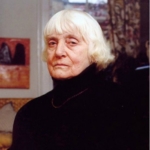
 We are extremely sad to learn of the death of author, playwright, poet, screenwriter and long-standing WGGB member and activist Maureen Duffy (pictured above and left).
Born in 1933 in Worthing, Sussex, her family originated from Stratford in east London, where she returned after her mother died when Maureen was just 15 years old. Her father had left the family when she was a baby and themes of her tough childhood and working-class roots are explored in her first novel That’s How It Was, published in 1962.
Her early passion for writing had been poetry, then while studying English at King’s College London, she completed her first full length play Pearson, which ultimately led to her being invited to join the Royal Court Writers’ Group in 1958. She started writing full time (after university she had been working as a teacher in Italy and London) after being commissioned by Granada to write the screenplay Josie – broadcast in 1961 on ITV. Numerous writing credits and awards followed. She received the Benson Medal from the Royal Society of Literature and in 2025 was announced as the inaugural winner of the RSL Pioneer Prize, founded by Bernardine Evaristo, to be awarded to a woman writer aged over 60 who has been a trailblazer.
Duffy was as much renowned for her activism as her writing. She campaigned for animal rights since the Sixties and was involved in early CDN marches. A humanist, she became the inaugural President of the Gay Humanist Group (which later became LGBT Humanists), and spoke on many issues affecting the LGBT+ community.
An active member of the WGGB from its earliest days, from 1985-1988 she served as President. During the TUC Conference of 1988, speaking to a successful motion, she deplored the passing of the controversial and discriminatory Section 28 amendment to the 1986 Local Government Act. WGGB would go on to become one of the first organisations to lend its support to the Organisation for Lesbian and Gay Action, critics of Section 28, and a campaign that was to last for over 15 years until it was repealed.
Authors’ rights was a cause very close to Duffy’s heart and one she passionately campaigned on. Alongside the author and activist Brigid Brophy (another WGGB member) and others she founded the Writers’ Action Group in 1972, which gained more than 700 members. Their long campaign for the Public Lending Right saw Duffy join a delegation to meet Prime Minister James Callaghan in 1976 – the first time a group of writers had been invited to Number 10 to lobby a Prime Minister. Callaghan had advised them that they would have a lot more clout if they had the strength of a TUC Conference motion behind them and in September 1977 Duffy attended the conference in Brighton to speak to the motion, where she faced over 1,000 delegates, describing it as “the most terrifying experience of my life”. The motion, seconded by the Musicians’ Union, was passed, despite last minute hitches which saw Duffy famously race to the front of the hall to have her say: “Why is it,” she demanded of the assembled delegates, “that everybody is paid and not the writers?” It was to be another two years until the PLR Act would be implemented, with Duffy attending every debate in Parliament.
She went on to help found the Authors’ Licensing and Collecting Society (ALCS), which she chaired for many years, more recently becoming its Honorary President. She also held roles at the British Copyright Council, European Writers Council and Royal Society of Literature and was an authority on copyright, intellectual property law and authors’ rights.
Those who remember her, remember above all her tireless tenacity in fighting for writers’ rights, not dimmed by her advancing age. WGGB General Secretary Ellie Peers recalls attending a British Copyright Council meeting at the beginning of her tenure as General Secretary, in which Duffy (now in her 80s) “was as fierce as ever – uncompromising, unmoveable and resolutely dedicated to protecting the rights of writers. You couldn’t ask for a better role model.”
WGGB Treasurer Gail Renard met Duffy when she first sat on the ALCS Executive Board “and did my best to learn everything I could from her. Her knowledge, enthusiasm and kindness were boundless, even in her later years. The word ‘trailblazer’ is overused, but not when used to describe Maureen Duffy.”
Renard remembers Duffy’s role in helping to found ALCS: “Her office consisted of a filing cabinet at the WGGB,” she said, adding “Whenever writers get our very welcome payouts from ALCS, please take a moment and remember Maureen. You wouldn’t have them without her.”
Our thoughts are with her family and friends.